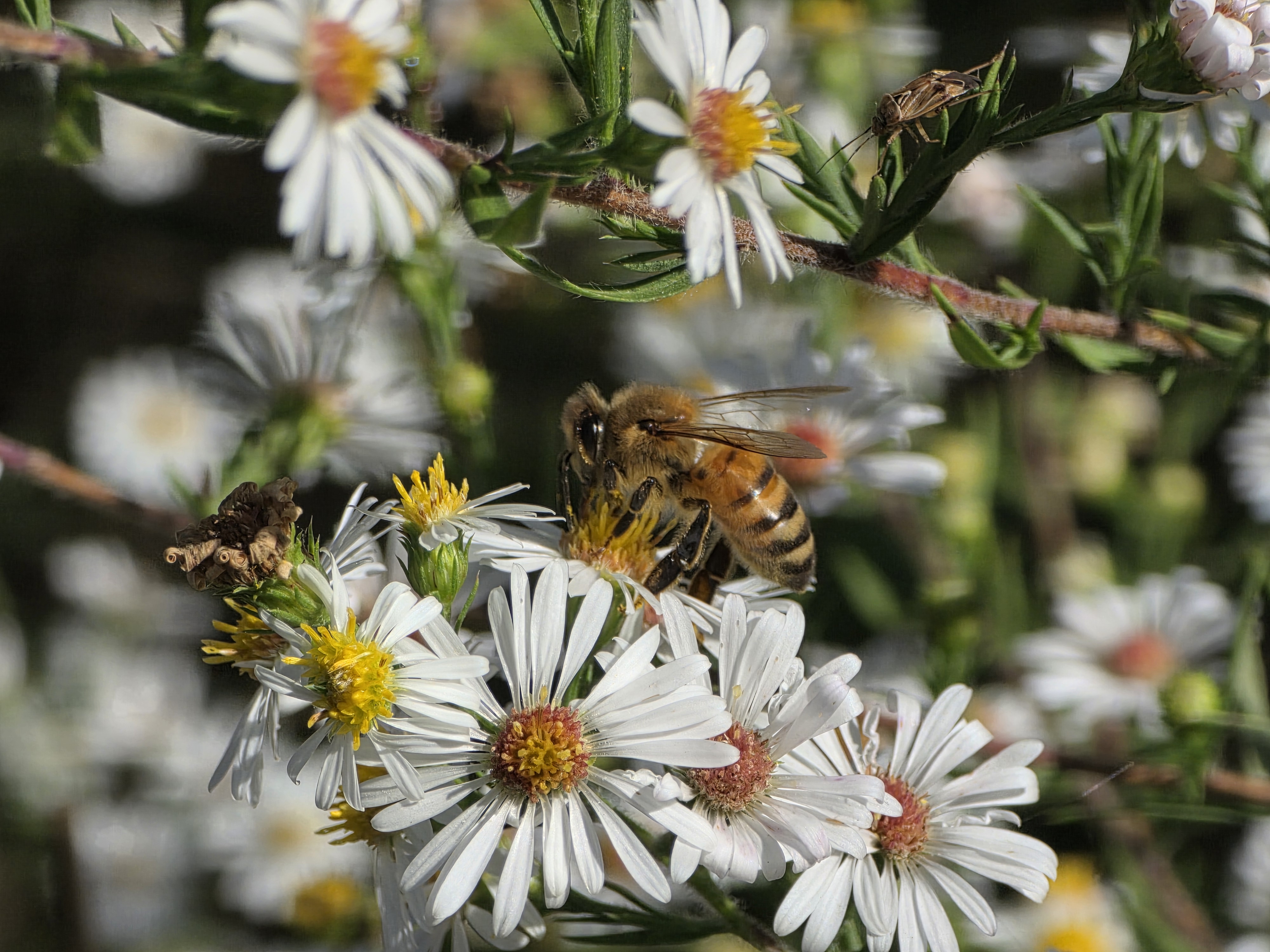
Honeybees are fascinating creatures. I’ve been beekeeping for just over five years and I learn more and more about them all the time.
When we go out to farmers’ markets, festivals and fairs, we speak to love to share our knowledge of bees and all their interesting quirks and amazing behaviors that the average person doesn’t think about.

Let’s start with this. There is a difference between a beehive and the bees themselves. Honeybees are a super organism. To understand honey bees as a superorganism, consider the following points:
- The superorganism concept highlights the interdependence of bees, emphasizing their role in ecosystems and agriculture.
- Honey bees function collectively, acting as a single entity rather than individual insects.
- They exhibit complex social behaviors, including division of labor among workers, drones, and the queen.
- Communication through pheromones and the “waggle dance” helps coordinate foraging and hive activities.
- The hive operates with a shared immune system, enhancing disease resistance among members.
- Resource sharing, such as nectar and pollen, supports the colony’s survival and productivity.
The bees live in a colony. This consists of one queen bee, the female worker bees and the males, called drones. The queen’s job is to lay the eggs for future generations of bees. The drones are the males. Their only job is to mate with the queens. The worker bees are responsible for everything else.

The colony of bees live in a hive. The hive is the structure in which the bees live. The bees themselves consist of a colony.

When people think “honeybee,” of course they think of honey. It’s absolutely delicious, sweet and amazingly good for us. Often called a “super food,” honey has many health benefits to people. Honeybees are the only insect that people “domesticate” to harvest food.
Honey is a “miracle” food that contains all the substances necessary to sustain life, such as water, minerals, and enzymes.

But honey is just a part of the picture of how bees benefit people. Up to 70% of our crops are pollinated by bees. This includes, of course, but not limited to our favorite, the honeybee.
You can help honeybees in at least a couple ways. First, don’t spray insecticides and other chemicals on your lawn. The bees will still do what bees do and attempt to collected nectar and pollen from the plant, but will bring the poison back to the colony, potentially killing all of them.
Second, don’t cut down flowering plants that you may think are weeds. More than likely, these plants are an important nectar and pollen source for bees. This is especially true in the fall when nectar foraging sources are few and far between. Fall blooming plants like golden rod, flea bain and witch hazel are critical food sources for honeybees when most other flowers have already disappeared for the season.

Lastly, you can plant pollinator friendly plants and flowers on your property. If you plant flowering berry bushes and fruit trees, not only will the bees have key nectar and pollen sources, the bees’ pollination will result in higher yields and even bigger fruit!
Honeybees are amazing bugs. We love our honeybees at Hilltop Haven. My calling them bugs isn’t to insult them, or other beekeepers. I use that term to put the following facts into perspective. It is easy to forget that honeybees are just insects. But their habits, behavior, organization of the colony and just how they go about the daily business of being honeybees is nothing short of, again, amazing.
Here is a list of some interesting facts about honeybees (https://www.factretriever.com/honey-bee-facts).
- To make one pound of honey, honey bees must gather nectar from nearly 2 million flowers.
- Nectar and pollen are not the same thing. Pollen is a protein and nectar is a carbohydrate. Pollen is fed to the bee larvae and queen bees. Nectar is stored in the honeycomb and is regular food for daily workers and drones.
- A single bee would need to fly nearly 90,000 miles, or three times around the earth, to make one pound of honey.
- A honey bee can fly approximately 5 miles during a pollen-gathering trip.
- Even though a honey bee’s brain is about the size of a sesame seed, it can learn and remember new things, such as how far it has traveled and how effectively it has foraged. We think they can remember people too. I visit my bees almost every day and it seems they know me the more often I’m with them.
- When a queen bee becomes too old to lay eggs, the other honey bees will either replace or kill her.
- Since 2006, scientists have become alarmed at what they have termed “colony collapse disorder.” Some possible causes they explored included global warming, pollution, and an increase of atmospheric electromagnetic radiation due to cell phones. Last year, Hilltop Haven lost two colonies. They were seemingly happy and healthy bees one day and just dead the next.
- The average speed of a worker honey bee is about 15–20 mph when flying to a food source. On its return trip, when it’s carrying nectar, it’s a bit slower, at 12 mph (19 kph). They create honeybee highways in the air. These can be up to 35 feet in the air.
- A queen honey bee can produce up to 2,500 eggs a day.
- When a virgin queen bee emerges from her egg, she locates other virgin queens and kills them one by one. Queens are the only bees that can sting over and over, and this is why.
- Honey bee queens control their hive by releasing pheromones known as the queen’s scent. “Control” means the colony can identify their own. Most of the big decisions are made by the workers. More on that in a future post.
- The amount and pace at which a queen lays her eggs is greatly controlled by weather and food availability. Her fertilized eggs become female workers or future honey bee queens. Her unfertilized eggs become male honey bees or drones. For example, the queen will slow the pace of egg laying in the fall, anticipating the upcoming winter.
- After a male and queen bee mate, the male bee dies quickly because his abdomen rips open when his endophallus is removed. Even if he survives, he is kicked out of the nest because he has served his sole purpose of mating.
- A colony of bees consists of 20,000–60,000 bees and one queen.
- While a queen bee can live up to 5 years, worker honey bees only live for about 6 weeks and do all the work.
- The wings of a honey bee produce its iconic “buzz.” Its wings beat 11,400 times per minute.
- Bees tell each other where nectar is by performing a “waggle dance. They also will choose a new hive by dancing directions to the other bees.
- Honey is the only food that contains “pinocembrin,” which is an antioxidant associated with brain functioning.
- A bee’s sense of smell is so precise that it can differentiate between hundreds of different flowers. It can also tell from several feet away whether a flower carries pollen or nectar.
- In its lifetime, the average bee will only make 1/12th of a teaspoon of honey.
- A bee’s wings beat 11,400 times a minute, or 190 times a second.

Different types of flowers bloom in different times throughout the season. When there is one flower that is predominantly in bloom, the bees will take full advantage of that and harvest as much nectar from those flowers as possible. When that happens, the resulting honey can have a distinctive flavor profile.
Honeybees used to pollinate apple orchards, for example, will produce a honey with a lighter, tangy honey when compared to honey produced from other flowers like buckwheat or sourwood trees.

We offer these different varieties of honey at our store in Cascade, MD.
The longer I keep honeybees, the more I realize how much more I have to learn. I find them a very relaxing, and educational vocation. Of course, we’re always grateful when their hard work yields such wonderful delicious and healthy honey!
Be sure to subscribe and never miss a new post!


Leave a Reply