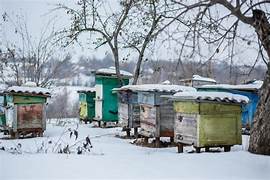
Honey bees face many threats. It would seem as though once the colony is well established, it is good to go and can be on autopilot. Unfortunately, this is often not the case. Bees face many threats throughout the year. Verroa mites, wax moths, a host of viruses, being robbed from neighboring colonies and even mice moving into the hive can bring disaster to even an otherwise strong colony.
Spring can be a very tricky time for your honeybee hives. From our experience in years of keeping bees, we lose more hives as the weather begins to warm than in the depths of winter. This doesn’t come from outside threats, but from the weather itself. This can be a tricky time for beekeepers trying to care for our hives too.
The bees have been buzzing around foraging nectar and pollen to store for when their isn’t any food to find and its too cold to leave the hive. Also, in the fall the queen will slow down and not lay many eggs to draw down the population of bees. Fewer bees means fewer mouths to feed through the winter.
When winter sets in and the weather turns cold, bees instinctively know what to do. To survive the winter, the bees will form a tight cluster inside the hive to preserve and share their body heat.

The cluster will move around within the hive to reach their winter honey stores so they don’t starve. This system works and the bees have been doing it for a very long time. The problem starts as the weather begins to improve.

In the Spring, there can be wide temperature swings between the daytime high and the nighttime low. This is great weather if you’re making maple syrup but not so good if you’re a beekeeper trying to keep your bees alive and have strong colonies.
Below is the weather forecast from March 10th to 17th in northern Maryland.

With days with daytime temperatures in the 70s, it is apparent that Spring is here or right around the corner. Under these conditions, honeybees will be out foraging. At Hilltop Haven Farms, there are no flowers blooming yet, not even the very early bloomers like crocus flowers or red maple trees. But the bees will get active at or above 54 degrees.
In the chart above, suddenly the temps take a dive and drop 43 degrees from the high of 78 on Tuesday 10 March to 35 on Tuesday 17 March. For the bee colony that is fully unclustered, that’s a dangerous turn.
Last year, we had a day where the temperature reached a very pleasant 62 degrees. The bees took advantage of it and we’re out looking for food. The next day, the nighttime low plummeted to 28 degrees. That sudden drop to below freezing killed one of our colonies. All of them were dead.
They say that if you ask 100 beekeepers a question, you’ll get 110 answers. Every beekeeper faces different situations and has different solutions. This situation, temperature rising and dropping like crazy in the spring, is what we’ve faced and where we’ve lost more bees than to any other threat. Other beekeepers will have different experiences with different results.
But, as demonstrated in the video above, it isn’t just our experiences.
The question is, if we watch the weather and know this is coming, what do we do about it?
We are approaching this by doing two things.
First, we are not unwrapping our hives until the threat of a sudden frost has past. Normally where we are in Maryland that is around mid-April. We’ll keep a close eye on the weather forecast and make an informed decision as to when to remove any wraps on our hives.
Secondly, we feed the bees. To prevent robbing, we use internal feeders with sugar water to help ensure that the bees have plenty of food inside the hive. With the warm weather, the bees will be out trying to forage, but there’s no food “out there” yet. By this time of the year, they may have gone through most, if not all, of their winter stores. We want to make sure the bees eat until the weather is consistently warm enough to not kill them. We also want to make sure they have something to eat until the first spring blooms appear.
At this time of year, we’re not concerned with any impact that sugar water feeding may have on the honey stores. Admittedly, nectar makes much better honey than does sugar water, but dead bees don’t make any honey at all. We’d rather have strong colonies than no colonies at all.
We’ve already lost 20% of our hives this winter. I haven’t had the opportunity to do any kind of deep dive examination of the hive to determine what happened yet. But with temps being well above 54 degrees this week, we can finally get in there.
If you’re a beekeeper, we’d like to hear if you’ve faced this situation before. Have you lost colonies from spring temperature swings? If so, what solution or prevention have you used to successfully get your bees through the winter, and more to the point, through the spring?
Let us and other beekeepers know in the comments!
Be sure to Subscribe and never miss a post!


Leave a Reply